Free walking tours and guided walks in NYC
There are two completely different things in this city called a free tour. One is paid for by the Parks Department, a conservancy or a volunteer. The other is a business where you set the price at the end. Here is how to tell them apart and what each is good for.
By Alex Oz · · 8 min read

Two different things get called a free tour
The first model is publicly funded or nonprofit programming. NYC Parks rangers, park conservancy docents, library and preservation-group walks, and volunteer host programs. Nobody collects money at the end, there is no ticket, and the guide is either on staff or a volunteer. The second model is the tip-based commercial tour: a real business, run by working guides, advertised as free because you decide what to pay afterward. Both can be worth your time. Only one of them is free.
The difference shows up in what you actually get. Publicly run walks tend to be short and narrow, focused on one park, one building or a few blocks, and led by someone with a specialist interest, which is why a ranger walk about hawks is better than any general highlights tour on the same subject. Tip-based tours are broader and more performative. Lower Manhattan in two and a half hours, the greatest hits, timed for people with one fixed afternoon and a group of strangers to keep moving.
One piece of background that surprises visitors: New York licenses tour guides. The Department of Consumer and Worker Protection requires a Sightseeing Guide license to guide people to points of interest or to describe or lecture about them. Getting one means a 150-question exam with 97 correct answers to pass, and the license runs two years, expiring March 31 of even-numbered years. Volunteer docents and city staff operate under their organization's own programs, but a guide working for tips is running a commercial tour, and you can look up any license through the department's license status search.
Urban Park Rangers: the biggest free program in the city
The Urban Park Rangers have run environmental and history programming since 1979, in all five boroughs, and NYC Parks states it flatly: all Urban Park Ranger events are free. No ticket, no suggested donation, no tip line. This is the single most underused resource for anyone who wants a guided walk in New York without paying for one, and it is the one I recommend first to people who live here.
The umbrella name for the public programs is Weekend Adventures, and the range is wider than most people expect: hiking, wildlife viewing, nature exploration, history and culture, astronomy, canoeing, fishing, archery, camping, nature art, photography and wilderness survival skills. Most run one to two hours. If what you want is a walking tour in the ordinary sense, the categories worth filtering to are hiking, nature exploration, wildlife viewing, and history and culture. The history and culture walks are the closest thing the city runs to a classic guided tour, and they often center on a fort, an old house, a burial ground or the construction story of the park you are standing in.
Registration is the part people get wrong. Most Weekend Adventures are first come, first served, so you show up at the listed meeting point at the listed time and join. A minority require advance registration or a lottery, specifically advanced canoeing, which needs prior experience, family camping, which is allocated by lottery because space is tight, and popular history programs with limited capacity. Read the individual listing rather than assuming.
Where the schedule lives
nycgovparks.org/events/urbanparkrangers
Ranger programming shifts with the season, with staffing and with the weather, so no printed schedule stays true for long. The official events calendar is the only version worth trusting, and it filters by borough and by program type. Parks also keeps a broader free and low-cost events listing that pulls in programming beyond the rangers.
Individual event listings carry a phone number for the nature center or park office running that program. Use it. These are outdoor walks and they get cancelled or moved for weather, and a two-minute call before you travel across a borough is the difference between a good morning and a wasted one.
Conservancy and waterfront walks
The park conservancies are the second tier, and they are inconsistent in a way that is worth understanding rather than guessing at. Some run genuinely free docent programs. Some sell tickets to their tours and give away excellent self-guided material instead. Neither approach is wrong, but the marketing does not always make the distinction obvious.
Brooklyn Bridge Park
Free, volunteer docents, no registration
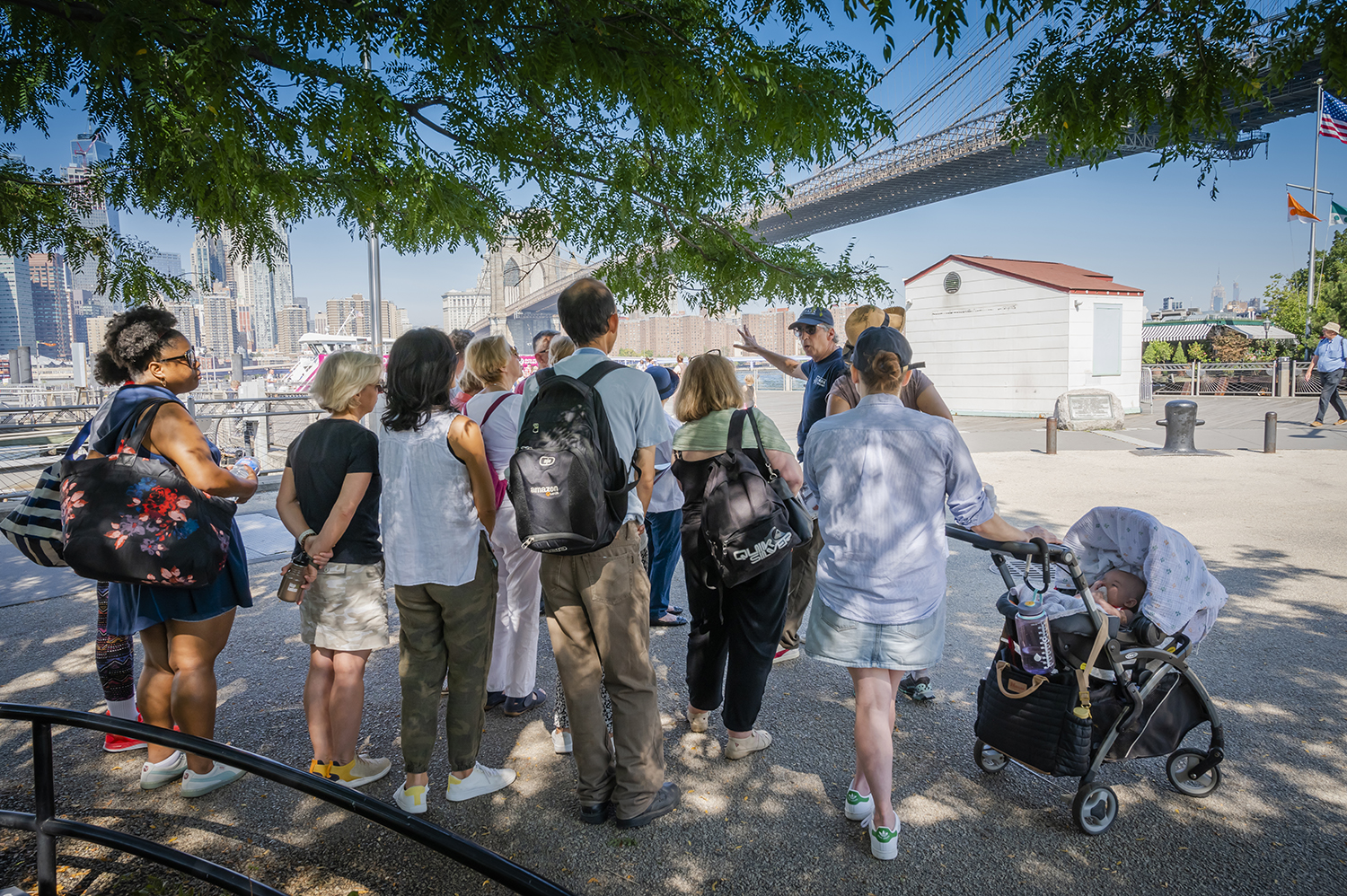
Brooklyn Bridge Park runs a free seasonal guided walking series called Waterfront Walks, led by volunteer docents, covering the waterfront's industrial history, the park's sustainable design and how the whole thing got built. No registration and no charge. The park also puts on free expert-led explorations through the year, including bird walks and horticulture sessions.
The series is seasonal, so there are stretches with nothing scheduled. When that happens, the park's free self-guided audio tours cover much of the same ground, including a walk through the site's history and a poetry-led tour about the bridge itself.
Governors Island
Free, volunteer-led, registration required
The Trust for Governors Island runs free one-hour walking tours led by volunteer guides, weather permitting, departing from Soissons Landing. These do require registration in advance through the Trust's site, and they run only during the island's open season. Check the current tour page before you plan around one.
The tour is free; getting there is not automatically so. Look up the ferry schedule and fares on the Trust's own ferry page, since fares, free windows and departure points have all changed over the years.
Central Park and Prospect Park
Ticketed tours, free self-guided material
The Central Park Conservancy's official tours are ticketed, with the fee going back into the park. That is a fair deal, but it is not a free tour, and I would rather say so than let you find out at the booking page. What the Conservancy does give away is genuinely good: a free digital guide on the Bloomberg Connects app with audio tours and historical background, plus downloadable self-guided tour PDFs for specific areas like the Ramble.
Prospect Park Alliance is similar. There is no standing free guided-tour program to point you at, but the Alliance publishes a free Bloomberg Connects guide covering the park's history, ecology and design, and it posts one-off walks and volunteer-led events on its news and events page. Check that page rather than expecting a weekly tour.
Big Apple Greeter is not a tour, and that is the point
Big Apple Greeter has been running a free welcome-visitor service since 1992, staffed entirely by New York volunteers across all five boroughs. A greeter takes up to six visitors on an informal, unscripted walk. There is no script, no set route and no fee, and it is not a tour in the commercial sense at all. It is closer to having a friend in the city who has agreed to show you their part of it for a few hours.
You request a visit through their form, which asks for your travel dates, the neighborhoods or boroughs you are curious about, your interests and your language. They will try to match you with a greeter who speaks it, and the list of languages they attempt to cover is long, including Spanish, French, German, Italian, Portuguese, Russian, Japanese, Mandarin, Cantonese, Arabic, Hebrew, Yiddish, Dutch, Czech and Swedish. You can also ask for a borough by name, pick the off the beaten path option, or leave it to the greeter's choice, which is what I would do.
Two practical constraints. Matching depends on volunteer availability, so request as early as your dates are firm rather than in the week before you fly. And they do not schedule greeters on your arrival or departure dates, recommending the first or second full day in the city instead. Everything else you spend is yours: your own transit fare, your own coffee.
Libraries, historical societies and preservation groups
Neighborhood preservation organizations run more free walks than most visitors ever hear about, because they market to their members rather than to tourists. Village Preservation, covering Greenwich Village, the East Village and NoHo, puts on more than 80 programs a year, almost all of them free and open to the public. Members get early notification and first chance to reserve, which tells you the practical thing: the good walks fill, so watch the events page and book the moment something appears rather than the week of.
The New York Public Library runs building tours at the Stephen A. Schwarzman Building on Fifth Avenue and at the Schomburg Center in Harlem. Schedules and whether a given tour needs a ticket change, so check the library's own tours page instead of a listing site. The Schwarzman building is also a legitimate self-guided walk in its own right if nothing is running when you are there.
Beyond those, the pattern holds across the city: borough historical societies, business improvement districts, and community preservation groups all run occasional free walks, usually tied to an anniversary, a season or a specific building campaign. There is no central calendar for them. The reliable method is to check the organization's own events page for the neighborhood you care about, and to treat any aggregator listing as a lead to verify rather than a fact.
Tip-based tours: how the model works and what to pay
A tip-based tour costs nothing to book and something to attend. The guide works for whatever the group hands over at the end, and in many operations the guide also owes the company a fee per head, which means a sparse tip round can leave someone out of pocket for a morning of work. That is the honest shape of the business, and it is worth knowing before you decide what to give.
For a number: Free Tours by Foot, one of the longest-running operators in the city, states on its own site that its guests tip on average a minimum of seven to ten dollars per person. That is a floor, not a target. My own rule after a decent two-hour walk is ten to twenty dollars a head, more if the guide was genuinely good or the group was small enough to ask questions, less if you had to peel off early or the group was forty deep and you could not hear.
The model has also drifted. Several operators now offer a choice at booking between prepaying a listed ticket price and choosing the pay-what-you-wish option, with refunds available on both if you cancel with at least 24 hours notice. So even the free version runs through a ticket flow, holds your booking details, and expects you to cancel properly if you cannot make it. A no-show on a free tour still costs a guide a slot.
None of this is a reason to avoid tip-based tours. If you have exactly one afternoon and want the Financial District explained by someone who does it daily, that is the product, and the good guides are very good. Just budget for it as a paid tour with flexible pricing, carry small bills because tipping happens on the spot and card handling varies, and ask the group size when you book, since that single number predicts the experience better than any review.
How I would actually plan it
If you live here and have a free Saturday, start with the Parks calendar and take a ranger walk in a park you have never been to. Two hours, no cost, and the history and culture walks in particular go places you would not have found alone. Pair it with something else in the same borough so the travel is worth it.
If you are visiting for a week, put in the Big Apple Greeter request as soon as your dates are set, before you plan anything else, because it is the one thing that depends on someone else's availability. Then fill the rest with conservancy walks and whatever the preservation groups have posted for those dates.
If you are here for a day and a half, book a tip-based tour and pay the guide properly. Trying to assemble a free morning out of scattered volunteer programming on a tight schedule is how people end up standing at the wrong entrance to a park at nine in the morning with nothing running. Free is worth planning around, not worth improvising around.
Whatever you pick, treat printed schedules with suspicion. Every one of these programs is seasonal, weather-dependent or staffed by volunteers, and the only accurate version of when something happens is the organizer's own calendar on the day you are checking.
Guided walks and tours coming up
Live listings for tours and guided walks across the five boroughs, free and paid, pulled from the calendar rather than a fixed schedule.
Updated Sep 8, 5:17 PM EDT
Open House at Ocean Breeze Athletic Complex
Waterfront Walks – September 8
Ongoing Outdoor Museum Exhibit: Alice's Terracotta Garden
Ongoing Museum Exhibit: New York's Brick & Terra Cotta Industries
Ongoing Outdoor Museum Exhibit: Alice's Terracotta Garden

Public Gallery Tour

Spotlight tour: Art
Ongoing Museum Exhibit: New York's Brick & Terra Cotta Industries
Keep going
- Free events in NYCEverything currently listed at no cost, tours included.
- This weekend in NYCMost ranger and docent walks land on Saturday and Sunday mornings.
- Free things to do this weekendWhat to build around a free walk once it finishes.
- Prospect Park weekend guideThe park where Alliance events and ranger programming overlap most.