Free yoga in NYC: where to actually find a class
The parks programs that are genuinely free, the year-round city classes almost nobody knows about, what donation-based really costs, and what to do once the lawns close for the season.
By Alex Oz · · 8 min read
The three kinds of free yoga in this city
Free yoga in New York falls into three buckets, and they behave completely differently. The first is the outdoor summer series run by park conservancies and trusts — Bryant Park, Brooklyn Bridge Park, Prospect Park, Hudson River Park. These are funded by sponsors, run roughly May through September, and are free with no catch. The second is Shape Up NYC, the Parks Department program that puts free drop-in fitness classes, yoga included, inside recreation centers and public library branches across the five boroughs, year-round. The third is donation-based and community classes at private studios, which are not free but are cheap, and where the etiquette around what you actually pay is unwritten and worth understanding before you walk in.
The practical difference is scale and season. The park series are large — sixty to several hundred people on a lawn — and they end when the weather turns. Shape Up NYC classes are small, indoors, and keep running in February. Studio community classes sit in between: a real room with props, for something in the range of a subway fare rather than a drop-in rate.
One thing is consistent across all three: you bring your own mat. I will come back to this because it is the single most common reason someone shows up and ends up practicing on grass.
The outdoor summer series
These run on published seasons that shift by a week or two each year, and individual sessions get cancelled for weather. Do not plan around a schedule you read in an article, this one included. Check the official calendar the morning of, and register where registration is offered — the registration list is how they email you when a class is called off.
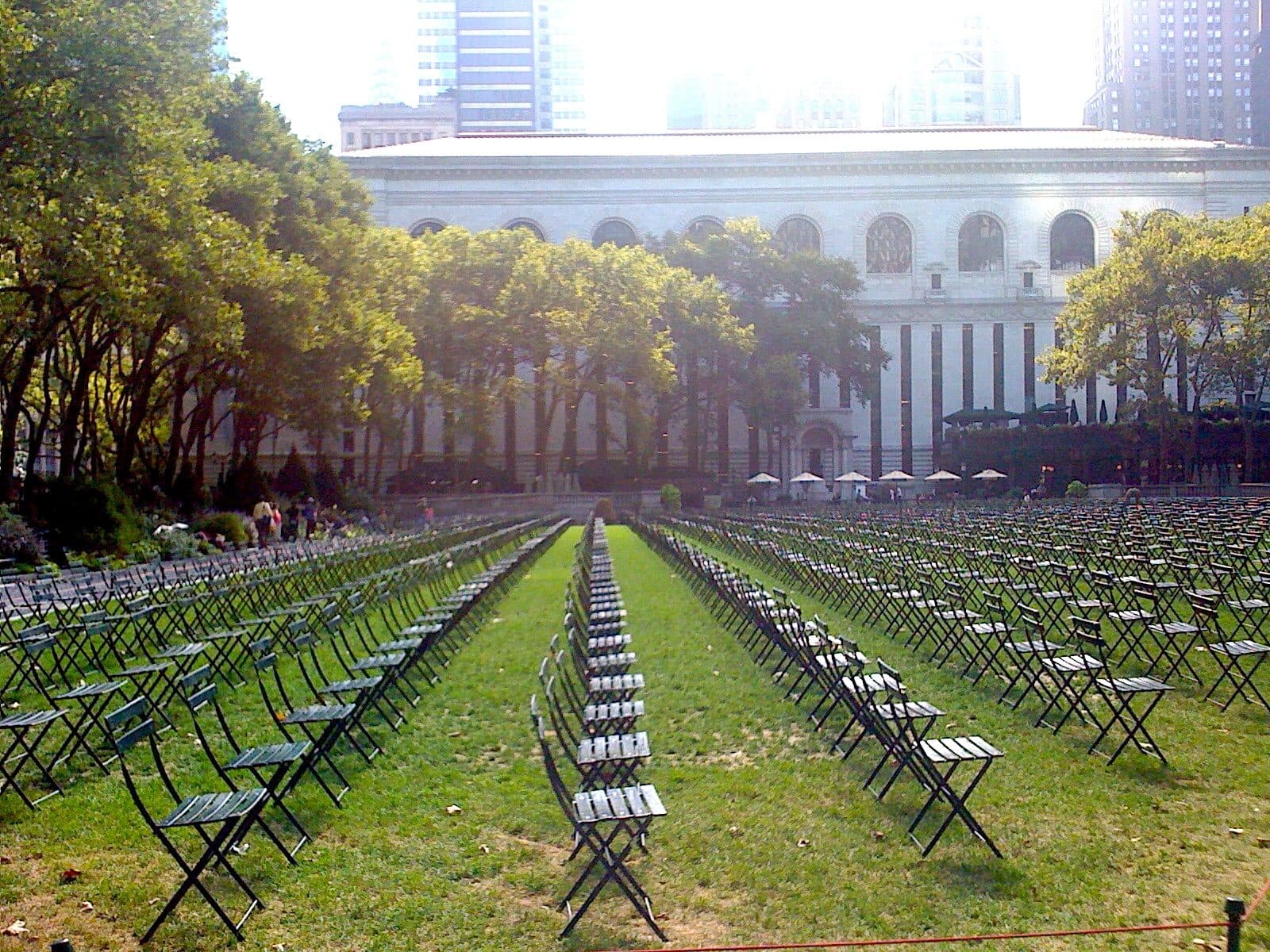
Bryant Park
Midtown Manhattan, late May through mid-September
The longest-running of the midtown series, free to the public, with two sessions a week during the season — one mid-morning on the Upper Terrace and one in the early evening on the lawn. The 2026 season ran from late May to the middle of September with a couple of scheduled gaps for park events, which is typical. Registration is required and handled through the event listing on the park's own site; pre-registration is strongly encouraged even though the classes are open.
Bryant Park does not provide mats. The park is explicit about this: bring your own mat and water. Classes are cancelled only when conditions are judged unsafe or uncomfortable, which in practice means light drizzle is not a cancellation. Registrants get an email; the park also posts day-of decisions to its Instagram account. The evening class has been livestreamed on Instagram in past seasons, which is worth knowing if you get rained out.
Brooklyn Bridge Park
Pier 3 Central Lawn, May through September
Yoga here is part of Waterfront Workouts, a free weekly slate that also includes Pilates, bootcamp, Zumba and a stroller run. There are two yoga sessions in a normal week — a Saturday morning class and a Tuesday evening sunset class — both on the Pier 3 Central Lawn, led by instructors from a Brooklyn studio partner.
Two things make this series different. First, a fitness waiver is required of every participant, but you only complete it once per season, so do it before your first class and you are done until next year. Second, advance registration is encouraged rather than mandatory: walk-ups are welcome as capacity allows, and you check in with park staff on arrival. The park keeps what it describes as an extremely limited number of loaner mats. Treat that as a backup for the day you forget yours, not a plan.
Prospect Park
Long Meadow North, June through late August
Prospect Park Alliance runs a free Thursday-evening class on the Long Meadow with a Brooklyn studio partner, with instructors rotating in from studios around the borough. The 2026 season ran from early June to the end of August. All levels are welcome, and the crowd skews genuinely mixed rather than advanced.
You need to RSVP and sign the waiver before your first class, through the partner studio's site rather than the Alliance's. Bring your own mat or a towel — the Alliance suggests either, and on the Long Meadow a towel is a defensible choice. Enter at Grand Army Plaza and walk in; the class is set up on the north end of the meadow, and on a clear evening you will see it from the path.
Hudson River Park
Piers 25, 46, 64 and 97, June through September
Healthy on the Hudson is a free class series that runs Monday through Thursday from June to September, each weeknight on a different pier: Pier 25 at N Moore Street, Pier 46 at Charles Street, Pier 64 at W 24th Street, Pier 97 at W 55th Street. Yoga is one class type among several — the rotation also includes Pilates, HIIT, conditioning and strength formats, each an hour, all levels.
Registration goes through the park's ticketing page, linked from its own site, and the park is direct that for yoga, Pilates, sculpt and strength classes you bring your own mat. Because the classes sit on piers, weather cancellations are more frequent here than on a sheltered lawn, and the park's own instruction is to check the events calendar for changes.
Shape Up NYC: the year-round option
Shape Up NYC is a free, drop-in fitness program from NYC Parks, and it is the most underused free yoga resource in the city. Classes run inside recreation centers, public library branches, and community sites in all five boroughs, and unlike the park series they do not stop in October.
The important detail: you do not need a recreation center membership to attend a Shape Up NYC class held in a recreation center. The program is free and open, and the class is separate from the center's paid membership. What you do need at a rec center is a padlock — the locker rooms require one and there is nowhere to leave a bag on the floor. Bring a mat and water as well.
The library classes are the easiest entry point if a rec center feels like a commitment. Brooklyn Public Library and the New York Public Library both host Shape Up NYC yoga at branches, usually as a one-hour session in a program room. These are free but typically require registration through the library's own event calendar, and many are listed as adults-only. The listings say plainly: bring your own mat. A branch program room has a hard floor, so this is not the class to attempt on a towel.
Because the roster of sites and times changes with instructor availability, the only reliable schedule is the Shape Up NYC event listing on the Parks site, filtered by borough, plus your local library's calendar. Search both — a branch class often appears on the library calendar before it shows up anywhere else.
Donation-based and community classes
Donation-based does not mean free, and studios that offer it are relying on you understanding that. In practice a donation class in New York carries a suggested amount, communicated at the door or on the booking page, usually in the range you would spend on lunch rather than the studio's standard drop-in rate. Payment is typically cash in a basket or a payment app handle taped to the desk. Nobody checks, and nobody is watching what you put in.
The honest guidance: pay the suggested amount if you can, pay less without embarrassment if you cannot, and pay more occasionally if you go regularly. The model works because the average holds up, not because everyone pays the same. If a studio has a stated sliding scale, the bottom of the scale is a real offer, not a test.
Community classes are the related category — a reduced-rate class, often taught by a recently certified teacher or a teacher in a mentorship program, at a fixed low price rather than a donation. The teaching is usually more scripted and the sequencing more conservative than a studio's regular schedule. That is not a downside for a beginner. It is often a better first class than a packed sponsored lawn session where nobody can see the front.
Since studios open, close and change their pricing constantly, check the studio's own schedule page rather than a roundup. What is worth asking specifically: whether mats are included, whether the class requires advance booking, and whether the donation is cash-only.
What to bring, and the paperwork
Bring a mat. Every program covered here either states you must bring one or keeps a handful of loaners as an emergency measure. A second thing worth carrying for outdoor classes is a towel, either to lay under the mat on damp grass or to use instead of one. Lawns hold dew well past sunrise, and a cheap foam mat absorbs it and stays wet for the rest of the day.
Water, and something to weigh down the corners of your mat if it is windy — a shoe at each end works. Sunscreen for morning classes, because an hour face-up on a lawn in July is more sun than it feels like. Skip anything you would mind sitting on the grass unattended; there is no bag check outdoors, and people stack belongings at the edge of the mat area.
On paperwork: the two rules that catch people are Brooklyn Bridge Park's fitness waiver, required of every participant but only once per season, and Prospect Park's requirement to RSVP and sign a waiver through the partner studio before your first class. Bryant Park and Hudson River Park both handle registration through third-party ticketing linked from their own sites. Registering matters even where walk-ups are allowed, because the registration list is the cancellation notification list.
Arrive ten to fifteen minutes early for the popular outdoor sessions. Not because you will be turned away, but because the good ground — flat, shaded, within earshot of the instructor — goes first, and on a large lawn the back rows are following the person in front of them rather than the teacher.
When the outdoor season ends
Sometime in September the lawn classes stop, and the free-yoga supply in this city contracts sharply. The replacement is Shape Up NYC. Rec center and library classes run through the winter, and this is the season when they are least crowded, because the people who found yoga on a lawn in July do not follow it indoors.
Bryant Park does keep a cold-weather fitness program going. In past seasons it has run indoor classes, yoga among them, in the enclosed space on the second floor of the skating pavilion at the Winter Village, through late February, with registration handled the same way as the summer series. Whether it runs in a given year and what formats are on the schedule changes, so check the fitness section of the park's site in November rather than assuming.
The other winter route is a recreation center membership, which is not free but is the cheapest gym access in the city and gets you into fitness rooms and, at some sites, an indoor pool alongside whatever Shape Up NYC classes are running there. Under the current published fee schedule, memberships for seniors 62 and over, veterans, people with disabilities and adults aged 18 to 24 are priced far below the standard adult rate, and youth memberships are free. Rates differ between centers with and without an indoor pool, and there is a discount for IDNYC holders. The membership page on the Parks site has the current numbers.
If none of that fits, the fallback most experienced practitioners land on is a home practice through the winter and a return to the lawn in May. The park series are consistent about coming back. Bryant Park has run yoga for well over a decade, and the Brooklyn and Hudson River series are now fixtures of their parks' summer programming.
Yoga and Pilates classes happening now
Current listings from across the city, including the free park sessions while the season lasts and indoor classes year-round. Check the organizer's page for registration and cancellations before you travel.
Updated Sep 8, 5:16 PM EDT
Hatha Flow

Yoga in the Park
Chair Yoga at Greeley Square Park
Yoga
Yoga with Bien Good Well
Yoga at Bryant Park

Summer on the Hudson: Yoga- Evening Salute to the Sun
Functional Yoga
Keep going
- Free events in NYCEverything currently listed at no cost across the five boroughs, updated as organizers post.
- Free fitness classes in NYCThe wider picture: bootcamp, run clubs, dance fitness and the other formats the park series run alongside yoga.
- NYC recreation centers guideHow memberships work, what each center actually has, and which ones host the most Shape Up NYC programming.
- Prospect Park weekend guideWhat else is happening on the Long Meadow and around the park if you are already there for a class.